Tuesday, August 16, 2011

Floating Semporna


Day 2 – 5 August 2011 / 1 Night


The Express Bus that we took from Tawau reached Semporna at about 4pm.

Harish and Rishi in Semporna town

Semporna is a town located in Tawau Division in the east coast of Sabah. It is located at the tip of Semporna Peninsula, and is visited by tourists as a base for scuba diving or snorkeling trips to the nearby islands off Semporna. The island that is most popular is of course Pulau Sipadan (Sipadan Island), said to be one of the top rated dive destinations in the world. Others are Pulau Mabul, Pulau Kapalai and Pulau Mataking.
Semporna town
Upon arrival in what looked like a run-down town, we took a long walk looking for one of the famous floating chalet in Semporna. As we were all much in need of a drink, we stopped for tea at a Mamak Restaurant (Indian Muslim). A plate of Mee Goreng cost us RM6! The town of Semporna is frequented by foreigners (especially Caucasians) on their way to the islands. So we were charged foreigner price.

The floating chalets of Semporna
We checked in at the Floating Chalet for a night stay a RM77. The chalet stood on stilts over the water. In fact, stilt houses are very common in Semporna. The majority of the Bajau people (locals) live in stilt villages on the outskirts of town. These Sea Bajaus are expert fishermen and boatmakers.


The room came with a Queen Bed, breakfast for two and an attached bathroom.

The boys in love with the room..they could see the ocean thru the cracks on the wood flooring
Guests can also visit the Semporna Ocean Aquarium for free, which we did. We walked on boardwalks and sat on the many benches and watched the sunset.


At the Semporna Ocean Aquarium

The bathroom was unique as the water from the shower went straight into the ocean below through the cracks. I did enquire if it’s the same with the toilets and the hotel staff assured us that toilets are connected with pipes to an underwater tank and these tanks are cleared once full.


We all liked this place as it felt so exotic like staying in a longhouse, where everything is connected in a bunch of zig zagging maze.
N outside our chalet
Me attempting a nice shot
A panoramic view of the floating chalets

N especially liked the bathroom as it was outside the room but still inside our unit; and very cowboy-styled; the top and bottom part of the door is bare, and everything is made of wood. It came with hot shower and a huge red container.


We also booked an Island Package for the next day for RM480. Yes, very expensive right? But it seems this is the cheapest of them all. The package included a return boat transfer at RM100 per adult and RM50 per child, an overnight stay in Mabul Island including 3 meals a day for RM60 per adult and RM30 per child and 2 snorkelling/diving trips per day. The boat transfer cost us RM300 and the board/lodge RM180.

The boats docked just outside our chalet
The boys had fun peeping through the gaps on the floor to see the ocean and fish underneath. We saw many fishermen boats in the sea and some had family units living in the boats. Were these people homeless, it looked as though the women were fetching their husbands after work by boat?

Harish against the sunset
After settling in, we took a long walk into Semporna town for dinner and as it was Ramadhan, many market stalls were visible. Food bazaars, roadside stalls selling vegetables, and small shacks selling Indonesian products. The ‘tamu’ or 'pasar’ (markets) were everywhere and jamming up the roads.

Rishi at the Pasar Tamu (Market Bazaar)
Night vegetable market
We couldn’t find any decent place to eat so we ended up at the Mamak Restaurant again. We packed ‘roti telur’ at RM2 each and headed back to the chalet. That night, the four of us shared one bed and cosily curled up as it rained heavily throughout the night.


A view during sunset
We could the boats leaving to the islands from our chalet

The one at the corner was our room

I liked the concept of stilt houses, villages, chalets and resorts in Semporna. This is a heritage of the Bajau community.


There is something else I noted, the foreigners (whites) in Semporna like to keep close to their own kind. Even to have an eye contact may be difficult. Its like I just want to do my own thing and get going. There was one guy sitting right next to our table who was so immersed in his laptop. never did he even look our way. The only time he did look was when the boys got a little noisy to his taste. I find this very rude, you come to a foreign land, you get away with all that's cheap, have your holiday, see our reefs and corals, but you don't want nothing to do with the locals. Like you are so wary of them. I saw this same behaviour in Mabul Island.  And I always had the impression that the Caucasians were the friendlier lots.


Some tips :-


1. Like Tawau, everything you need in Semporna is just a walk away.


2. You may not find that many restaurants or fast food outlets, but they are there, just look for them


3. Be prepared for a lesser clean town, as we saw rubbish strewn roads, pavements at many places


4. Be warned of spits, as in saliva...I have another update on this in my 'Spitful Semporna' story


5. Nearing the dock, is where the whites/foreigners hang out and there are special food outlets catering to them, so if you were to patronise these food outlets, you may end up paying their price.

All photos are copyrighted. I can be reached at sivakay2009@gmail.com.


Ravaged Tawau

Day 2 – 5 August 2011

Feeling excited, we got up early and prepared ourselves to explore Tawau town, see how far our legs will carry us. Tawau can be divided into 3 main areas :-

(1) Tawau old town where the Tawau Port is
(2) Fajar area where the heart of town is (akin to Bukit Bintang of KL), you can find banks, hotels here and;
(3) Sabindo area (govt office, bus terminal etc).


Tawau Old Town - the port

Another view of Tawau old town
We walked to a Chinese coffee shop nearby and had egg tart, char koay with butter and kaya, fried mee and toast. The bill came to about RM13.80. So we now knew that the price of food in Tawau is about the same as in KL if not more.

Tea with egg tart


Tea and char koay spread with butter/kaya


Harish only wanted the fried mee with ketchup and Milo though I tried to get him to try something new..


Rishi with his favourite egg tart


A short walk away is the local bus stand. We thought of visiting the Cocoa Museum located in the compound of the ‘Majulah Koko’ factory in Tanjung Batu Laut and so, we took a bus heading that way.
 

Tawau local bus-stand
It was hot in the bus and the conductor made sure all seats were filled before the bus took off.

Again almost everyone in the bus were either Malay or Indonesian. The conductor stopped us right in front of the factory, but alas, we didn’t get pass the security. Although we were guests of the hotel whose owner is also the owner of the Cocoa Factory and Museum, we were told that we needed advance booking with the company. They only run guided tour in groups and it is about RM100 for 5 pax, inclusive of lunch made from cocoa products.

Who would pay RM100 to visit a museum and factory??? So we gave it a miss. I think the Cocoa King instead of allowing visitors to at least see the museum for free, has commercialized the whole thing.

So, we jumped into another bus heading back into town. The ticket was RM0.80 per person/seat. We didn’t buy tickets for the kids as they sat on us; you can easily shift seat when someone gets off. The bus ride was well worth it as we got to see the locals and their villages along the 3km road.

The boys with N in the bus ..

Before walking back to our hotel, N suggested we take a look at the port activities nearby. After all, Tawau is a port city. We saw huge boats loading and unloading fish and other marine life.


The port -  jetty and boats


The classic fishermen boat

The dock borders a Fish Market (Pasar Ikan Tawau).

Pasar Ikan Tawau (Tawau Fish Market)
I was so reluctant to enter as I could smell raw but fresh fish everywhere, and the floor was filthy and wet.

But we went in anyway and it proved so educational for the boys and us. We saw so many types of fish, crabs, clams, oysters, seaweeds, shrimps, lobsters, squids etc etc and were very much taken in by the sheer colours , shapes and sizes.

Crabs

Pretty fish


Red fish
Mussels

The fishermen and fisherwomen were friendly and allowed us to photograph and even posed with their biggest catch.


Harish with a friendly fishmonger - that's a big catch!

I couldn’t help but notice some Towkays and Madams loading fresh catch for their seafood restaurants. They buy the fresh catch at a low price and sell it at exorbitant prices as seafood in restaurants. If in Tawau, please buy fresh and cook your own fish, so much cheaper. Having said that, as tourists, this may not be practical.

Once done, we walked back to the hotel and checked out by 12noon. N stayed on for lunch provided by the hotel and I walked with the boys to the nearest Chinese Chicken Rice Restaurant. One set of chicken at RM4.50.

We then took a cab to the Sabindo Bus Terminal for our onward journey to Semporna, the exit point to the islands. Semporna is about 90km from Tawau. The ticket for the A/C bus is RM10 per seat and it takes about 1 ½ hours to reach Semporna.


The Express Bus to Semporna - the boys waiting inside the bus

All along the route, you can’t help but notice the forest cleared for oil palm cultivation. This is the reason I say Tawau has been ravaged.


Miles and miles of oil palm trees

When one thinks of Borneo, one imagines rainforests and wild animals. But what we saw along that Tawau-Semporna route was just oil palm trees on both sides of the road. It stretched till the foothills and onto the hills.. So much of primary forest cleared. Only god knows what happened to the wild animals and insects that roamed the forests? According to Malaysian Palm Oil Company, Sabah is the largest palm oil producer in Malaysia. I could see why…

Think I just digressed again, back to our travel story now…

I liked the roads, well maintained and connected. I also liked the locals, all of them - from the coffee shop Chinese uncles, the Indonesian workers, the bugis cab driver, the Suluk  fishermen, they all seemed friendly and approachable.


Some tips :-

1. Be prepared for reality as all that you had read and prepared to discover may not be true; the cleared forests was one hard reality for me to swallow

2. Be respectful of the locals' cultural and religious practices - for example if you know it is the Ramadhan month (means fasting for Muslims), try not to eat in front of them like while you are in a cab or in conversation with them

3. Be prepared for Muslim restaurants closing shops during daytime in the month of Ramadhan - for example the Indian Muslim (mamak) restaurants in Tawau. BTW, Mamak restaurants are Malaysians' typical hangout.

4. Be brave to do what the locals do - like getting into their buses and just flowing with it ; and you can trust the drivers and conductors to help you

5. Know the names of towns and locations of places of interest and don't hesitate to ask the locals the way - the worst that can happen is they won't be able to speak English but still help refer their friend who can

6. If you are not a Malay or Chinese, be prepared for lots of staring

7. Tourism in Tawau has not quite picked up, so if you are a tourist, you may be charged slightly more

8. Food in Tawau is NOT that cheap, so come prepared.


Silent Tawau

Day 1 – Tawau, Sabah (4 August 2011 / 1 Night)

On the morning of 4th August 2011, the boys were very much looking forward for the Sabah trip and were naturally excited. Our flight was at 6.30pm. I had just enough time to finish packing our things in the AM. We went out for breakfast and planned to leave by 1pm but left only at about 1.30pm.

Rishi and Harish just before we left the house
N drove to the LRT station and parked our car, then we boarded the LRT. We each had one bag to carry.
 
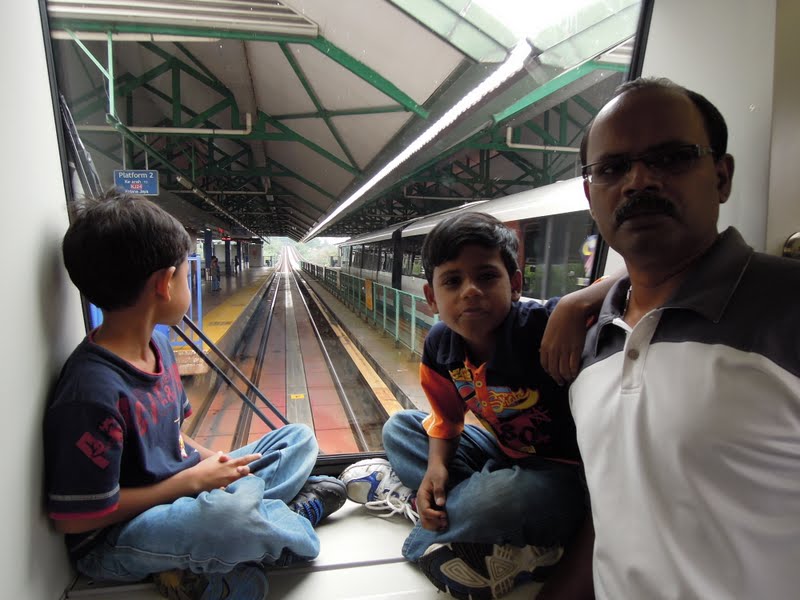
Harish, Rishi and N in the LRT
 

We reached KL Sentral at 2pm and bought some pre-packed food for lunch. From KL Sentral we took the SkyBus to LCCT at 2.30pm. I had earlier web checked in our tickets and printed our boarding pass. After what seemed like an eternity, we boarded the plane at 6pm.

We arrived at Tawau International Airport at 9.25pm. The airport was quite empty and quiet.


Tawau International Airport

Luckily, I had the foresight to arrange shuttle service to our hotel when we booked our accommodation. The hotel staff stood at the entrance holding a paper with my name flashed on it. We followed him to the van. The road was well lighted and maintained and the ride was smooth but so eerily quiet.

The driver told us he is a Suluk Malay, Philippines origin. Took us 30mins to reach Tawau Old Town. The airport road was well lighted and looked new. Although I was told during booking that the charge is RM15 per adult (no charge for kids below 12), we paid RM45 for the 30mins ride to the hotel. This is the rate charged by airport cabs too.

The last bus, for your info, leaves the airport at 6.30pm, the bus fare is RM10 per seat. It’s an air-conditioned bus. But if your flight arrives after 6.30pm, you have no choice but to take the cab. Otherwise, try enquiring at 'car for rent' office in the airport.

Checked in at almost 10pm. No greeting and no opening of door by hotel staff. We carried our own luggage in. The promotion rate of the hotel was RM88 with breakfast for 2. You can also opt for lunch at their restaurant or via room service for RM15 for 1 person.


The hotel reception area - cocoa merchandise on display and sale

There was one Chinese Towkay (meaning the Boss) who looked at us as if we were ‘aliens’ from behind his glasses. He never got up to say hi or smile. We could see that the staff feared the boss. The staff were local Sabahans.

We dumped our bags in the room and headed to the nearby KFC for a late dinner. Surprisingly, it opens 24 hours. The town looked and felt dead quiet.

Harish lost in thought ...view from our room, you can see the sea and port


The room came with one Queen Bed and one Single Bed. The bath had a tub, a cocoa soap and cocoa body wash. It was okay.


Real cocoas nicely arranged as display

The boys dashed for a long hot bath, somehow they can’t resist bathtubs and hot showers. We could see Tawau town and the Celebes Sea from our hotel.

I liked the town as there seemed to be some planning here, roads were clean and wide, and everything is just about a walk away.


Some tips :-

1. Be prepared for late arrivals and make prior arrangements for airport transfer

2. Better to book accommodation for the first night in advance

3. Have a list of hotels and their rates ready; in fact do loads of research on the place

4. The town is rather laid-back and slow moving; and is not very happening, so if you are from big cities, you will get bored easily

5. Be assured that there will be food outlets operating into the night; you just need to find them


All pictures are copyrighted. I can be reached at sivakay2009@gmail.com.


Intro to Tawau, Sabah

Tawau and Semporna - 4th till 9th August 2011


If you are wondering where is Tawau, well, it is located in the South East Coast of Sabah and faces the Celebes Sea (see maps below). Sabah is the second largest state in Malaysia after Sarawak. It shares a border with Kalimantan, Indonesia in the south. Sabah is divided into 5 administrative divisions, Tawau Division being one of 5.  Tawau Division comprises of 4 districts which is  Tawau, Semporna, Kunak and Lahad Datu.

The places we visited were Tawau and Semporna.


Map of Malaysia showing the location of Sabah state
Map of Sabah showing the location of the Tawau Division

Map of Sabah showing the location of Tawau & Semporna

According to 2009 census (Wikipedia), Tawau has a population of 474,728. 41% are Malaysians and the rest are non-Malaysians, to be exact, Indonesians 59%!.

Shocking yes but this is the reality! 59% non-Malaysians….that explains it all. No wonder we felt like we had landed in Indonesia. Seriously, being in Tawau makes you doubt whether you are really in Malaysia. Non-Malaysians outnumber Malaysians….so strange yet true. How did this happen? Some govt departments sleeping on their jobs? Or making money through corruption? Perhaps some attempt to increase the Muslim population? Or increase vote banks? I can only guess.


From a total of 192,694 Malaysian population in Tawau (Wikipedia), 18% comprise of Chinese (Hakka origin) while the rest comprise of Malay, Dusun, Kadazan, Bajau, Murut and other Bumiputeras (natives).

We met Indonesians of Bugis origin (from Sulawesi, Indonesia), Suluk origin and Timor origin and they seem to have comfortably settled down in Tawau to make a living. They said life in Indonesia is hard (poverty) so they ventured via boats (sometimes over 3 to 4 days) towards Tawau’s coastline. These were pleasant and helpful folks. We also met people of Philippines origin whose parents came here in the 70s and 80s from Mindanao.

The Chinese are mainly concentrated in Tawau city, and they are the rich ones. We noted this immediately . They drive MPVs like Toyota Hilux and other expensive vehicles and own almost all shops and businesses. What is with the MPVs, we saw so many in Tawau town?
 
If you pass a row of shoplots, you can be sure that majority if not all are Chinese owned and run. We heard that the Chinese Sabahans are richer than their West Malaysian brothers. And the further you get away from the town centre, the more of such Chinese businesses you will see.

The disparity between the lifestyle of the Chinese locals and the others hits you smack on your face, you can’t help but notice. Chinese businesses employ Indonesian girls to work at their restaurants and shops, and local Sabahans. I guess labour must be cheap. But then, the Chinese were early settlers as far back as the 1800s and always the enterprising lot.


But I digress…I'll go back to my travel story now.

I can be reached at sivakay2009@gmail.com.


Tuesday, June 28, 2011

Part 6 - Rajaraja Chola's Tanjavur

Part 6 – Tanjore, Tamil Nadu (14 June,2011)

On 14 June 2011, we decided we will visit Tanjore, 60 kms away from Trichy. Tanjore is an ancient city of India with a long history dating back to the Sangam period. The Great Chola Living Temple which is a UNESCO Heritage Site is located here. It is called the Brihadeeswara Temple, otherwise known as the 'Big Temple'.

The temple was built by the great Rajaraja (Emperor) Chola.

Inside Tanjore local bus - the helpful conductor

So, we took the bus from Trichy Central Bus Stand to Tanjore, tickets RS16 each. From Tanjore Main Bus-Stand, we took a local bus to the ‘Big Temple’, tickets RS4 each.


The 6 Places that we visited on our own in Tanjore were :-


1. The Brihadeeswara Temple

2. Vijayanagara Fort

3. Tanjore Palace

4. Saraswathi Mahal Library

5. Sangeetha Mahal

6. The Art Gallery


1. The Brihadeeswara Temple

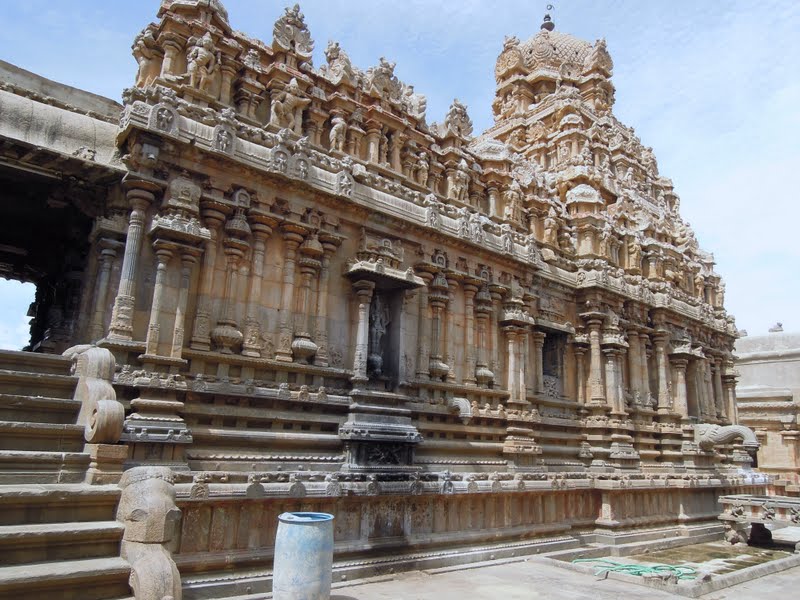
This is a 11th century temple built by Rajaraja Chola. The entire temple structure is made of hard granite stones. It seems it took only 6 years to complete. The walls of the sanctum are covered with wall paintings depicting Chola and Nayak periods.


The Great Chola Living Temples of Tanjore
Panoramic view of temple complex

Tanjore Big Temple - main entry

The description
The first gopuram - at the entrance


So magnificent...

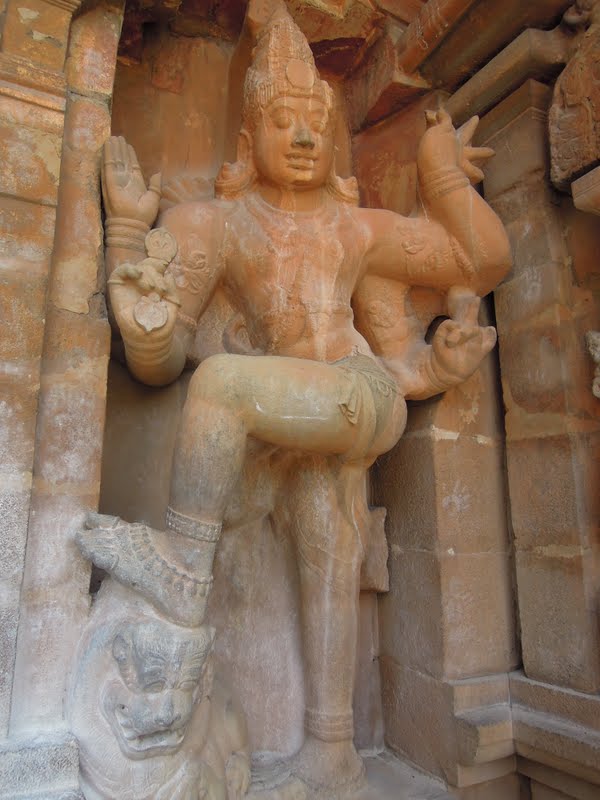
Dancing pose
The old Tamil inscription
More shots of the temple

One section of the complex
Me at the UNESCO site

The blessing itself - is that a smile on the elephant's face?

This by far is the most captivating temple of all that we have seen in our India trip. It stood so solid against natural earth and sand colours. It seemd no cement was used in its construction. Just astounding! I hope this temple is kept as it is for a long time.

We paid RS90 for entrance and camera. And there is a safe shoe-storing area for free inside the temple complex.


2. Vijayanagara Fort

The fort was built in 1550AD by the Nayaks and Maratha rulers. The Tanjore Palace, Sangeetha Mahal, Saraswathi Mahal Library and the Art Gallery are located inside the fort.
The fort in ruins
More of the fort

 3. Tanjore Palace


The Tanjore Palace is about 2km from the Big Temple. It was built by Nayaks and Maratha rulers from 1532AD. The palace’ courtyard leads to a many-pillared hall. There is an imposing Tower which rises from the palace roof. It has six storeys and we climbed all the way up.

The palace central courtyard
Tanjore town viewed from the Palace Tower - the Big Temple very much visible

Tanjore Palace

The one-minute Maharajah

4. Saraswathi Mahal Library


The library was established around 1700 AD and keeps some of the oldest manuscripts in palm leaves. You can find ancient maps and nadi shastra here, including vast number of ancient manuscripts, both Indian and European. 80% of its manuscripts are in Sanskrit, many on palm leaves, some on paper.

The Sarawathi Mahal Library
Although we would have liked to stay and browse longer at the displayed manuscripts and maps, we were politely asked to leave quickly as they close for lunch at 12.30pm and re-open 3pm. We only had about 15mins to browse.

We weren't happy about this, and made it known in their 'Visitor's Log Book'. The management should look into a staggerred lunch break so that the place remains open and accessible to visitors.The staff told us they had only half an hour lunch break and so had to close. Very disappointing.

The other fact is visitors cannot access the library as only researches are permitted. Reason given was visitors may mess the arrangement order of books. Doesn't sound like a good enough reason to me.


5. Sangeetha Mahal

Sangeetha Mahal is in the first floor of the Tanjore Palace. This was the place where musicians and dancers performed in front of the Chola and Nayak rulers.  It has now been converted into a Handicraft Shop.

Sangeetha Mahal

We bought the famous Thalaiyatti Bommai (head-nodding doll) as souvenir for RS230.


6. Art Gallery

Tanjore Art Gallery was started in 1951 and is located in the Audience Hall or the Durbar Hall of the Tanjore Palace. On display are the bronze and granite sculptures of the Chola period from the 9th to 12th century.
A deity with my name...
stone statues from 9th-12th centuries

Lord Shiva's various dance poses


Inside the art gallery
 For lunch, we took an auto (RS40) to a non-veg restaurant and had Chicken and Mutton Briyani for RS195. Less spice and tasted all right.

The road outside the restaurant

Then we walked to the Tanjore Bus-Stand to head to the Main Bus-Stand but were unable to beat the rushing crowd. The buses we noticed never stopped at the platform but a short distance away so groups of people dashed to board the bus, some just about hanging onto the bus. We just took an auto instead, RS90.

We got down at the Main Bus Stand and took the Trichy headed bus.

Tanjore Bus Stand

The next and last day was our flight of departure from Trichy Airport.


Some Tips :

-To get to the ‘Big Temple’, just ask any local or the bus drivers, they will tell you which bus to take and where to get down. The helpful conductor of the local Tanjore bus that we took informed us when we neared our stop. The stop is very near to the ‘Big Temple’. And the best part, every other place we visited were located just within walking distance of the ‘Big Temple’.

-Do a guided tour for the ‘Big Temple’ if you can; as we were privy to some details that we would have missed if not for the guide. On one of the huge gopurams, the guide pointed out a sculpture of a British Officer in a cap and uniform. Seems the rulers then did this to please the British rulers. And there it was, right on top of a sculpture of Lord Muruga. We paid the guide RS100 for the one hour tour.

- This is one temple where you don't find shops, bazaars or beggars within its compound.

- As much as you want to go local, when it comes to extreme risks, opt for second best eg choosing an auto rather than a packed bus


End of journey, adios …


On 15 June 2011, we checked out and took an auto to Trichy Airport. Modern, spacious and clean. We paid RS120 for the ride. We checked in our tickets and had breakfast in the airport (nobody queued at the food outlet, yes again!).


Signboard outside Trichy Airport
N just before entering the airport

Inside the waiting area
The planes
We departed India at 9.15am.


Temple elephant on lunch break


Note : All contents and images in this blog are copyrighted, please contact sivakay2009@gmail.com if you need info.


Photos : NIKON COOLPIX P300